
- Module in Python with Project (Rock Paper Scissor) -

Module in python 
● A module logically organizes Python code. 
● Groups together related code. 
● Makes the code easier to understand and use. 
● To use the code in a module we need to import it. 

Syntax: import <module_name>

           
Example Code to Generate a random number between 1 and 100

import random
print(random.randint(1,100))

● In the above code, we are using a ‘random’ module.
 ● To use code in a random module, we need to import it (first line) 
● random. randint(a,b) generates a random integer between a and b inclusive of them.

 Note:  random, helps us to use randint which generates a random number. 
Run the code multiple times and see how a different number is generated each time.

To develop a rock paper scissor game in python the rules can be

 1. You choose any of the 3 options- rock, paper, scissor

 2. Your opponent also chooses the option 

3. Now considering the choice made, a. paper vs rock ->paper scores b. rock vs scissors ->rock scores c. scissors vs paper ->scissor scores d. if both same->tie

 4. The one who scores the most in 10 rounds; wins the game.


The python concepts that will be covered in this game are:
● Variables
● Data types
● Operators
● if ,if-else , elif 
● for loop, while loop

Algorithm :

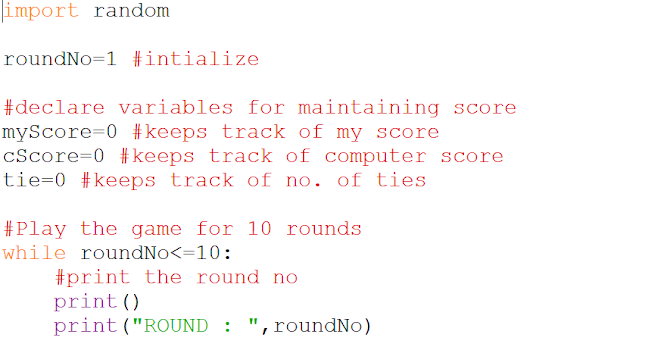
 1. Initialize variables used to maintain score to 0
 2. Initialize variable to maintain round to 1. 
 3. Loop till round<=10.
         a. Get user choice.
         b. Get computer choice.
         c. Compare user choice and computer choice and increment score.
         d. Display current score e. increment round.
 4. Compare the scores and print the final result.

Before moving on to developing the game, let’s see what is a module in python. just like you organize your clothes in the Almira?. 
● uniform 
● party dress 
● casual dress
● home dress etc Similarly you can organize your code also.

 
code for the game -RockPaperScissor. 


Comments

Popular posts from this blog

- Object Oriented Programming -

In OOP, we can represent an entity using a class.  A class bundles data (features/properties of entity - color, height, width) and functionality (movement, expression) together.  An instance of a class is known as an object.  Which is the only cartoon series that had predicted that Trump would be elected as the president of the USA and also predicted the coronavirus spread?   Answer: Simpsons.  Simpsons is a very popular animated show. You can build something similar with python.  But have you ever wondered, how Simpsons look the same in all the series? Only his movement looking and, expression change but his main features like color, height, and face look exactly the same all the time.  This is because we create a ‘blueprint’ of Simpsons and whenever we have to simulate him on screen we use this blueprint. This keeps a record of all the features of Simpsons and recreates it whenever we want.  This is where Object-Oriented Programming(OOP) h...

– Sequences, Algorithms and Programs in Python ---

 Before moving forward, Let's learn how to install Python software in your System which is very important for the further understanding of these topics. Imagine, you are a regular customer of Uncle Sam’s Pizza restaurant, can you help Uncle Sam prepare the menu and take a printout of it? Which application will you use for that? You will type the menu using MS word and then take a printout of it. right?  So, you know that we can use MS Word to create documents. Similarly, if you want to write a python program, you need an IDE (Integrated development environment). This IDE helps you to write a python program and then run it so that you can see the result/output of the program.  Steps to install python/IDE in your local system. (Windows /MAC )   Note : Prerequisite for installing python in Windows- Windows 8 or above. go to this website .   1. Click on download python as per your OS. Mac users may download the Mac version. Windows users download depending on 32-bit...

-List Slicing in Python-

 List Slicing : Slicing helps in creating a new list from an existing list.  Syntax list_name [start :end:step] Suppose you have a list of Avengers, arranged in the order of your preference.   avengers=[“Iron Man”,”Thor”,”Hulk”,”Spider Man”,”Captain America”,”Black Panther”,”Hawk Eye”,”Vision”,”Black Widow”] Later you decide to split them into a separate list like  favourite=[“Iron Man”,”Thor”,”Hulk”]                                                   less_favourite =[”Spider Man”,”Captain America”,”Black Panther”]                             least_favourite=[”Hawk Eye”,”Vision”,”Black Widow”]  Now, we have 3 lists formed from the main list. Would you want to create these lists again from the beginning? This is where list slicing helps us. Here is the code to  G...